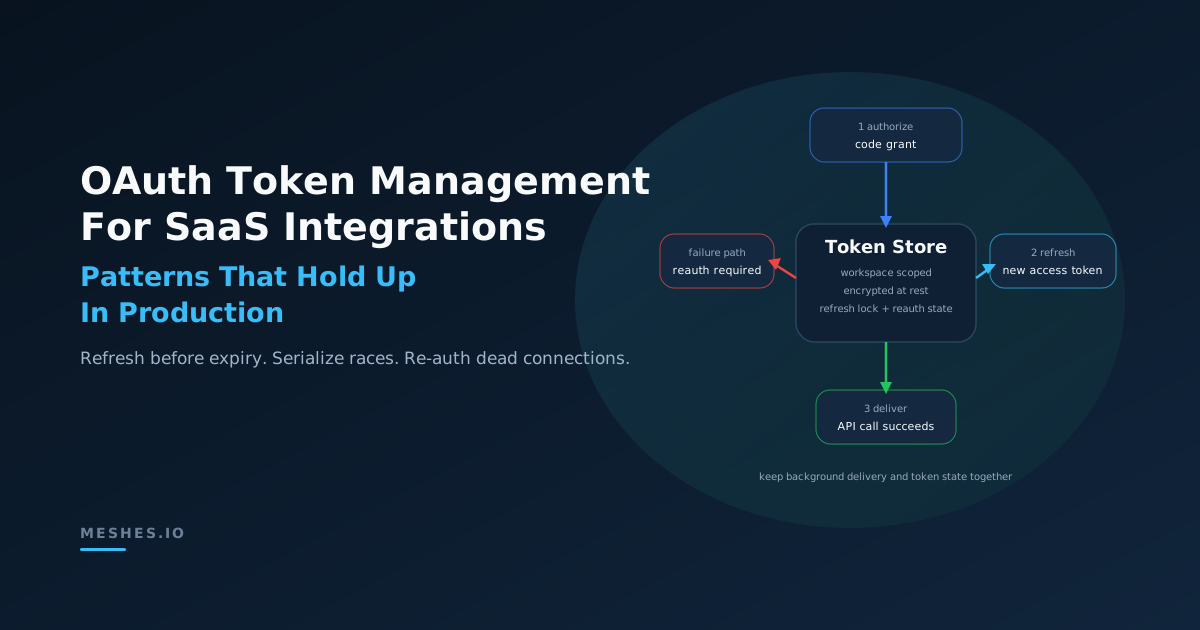
OAuth Token Management for SaaS Integrations - The Patterns That Don't Break at 3am
OAuth tokens do not fail on schedule. They expire during jobs, race during refresh, and get revoked without warning. Reliable SaaS integrations need a token lifecycle strategy.
Customer-facing OAuth integrations need to keep authorized connections working long after the initial handshake.
A token expires halfway through a delivery batch. Two workers refresh the same connection at the same time. A customer revokes access in the provider UI and your system keeps retrying with a dead credential until someone gets paged. One provider rotates refresh tokens. Another only returns one on the original grant. A third changes behavior depending on connected-app policy or consent mode.
This is why OAuth token handling becomes operational infrastructure long before it feels like it should.
For customer-facing integrations, a token store is not enough. You need a token lifecycle strategy.
What is SaaS token management?
SaaS token management is the operational layer that keeps customer-authorized API access usable after the first OAuth handshake. For integrations, it means storing token state per workspace, refreshing access before delivery, preserving refreshed token versions safely, and turning revoked consent into a clear re-authorization state instead of endless retries.
A good SaaS token management design answers five questions:
Which tenant and provider account owns this connection?
Is the token fresh enough for the next background delivery?
Can only one refresh update the connection at a time?
Does a provider error mean retry, refresh, or re-authorize?
Can support see why a customer connection stopped sending events?
That is why token handling belongs next to connection state, delivery status, and customer-visible remediation instead of living as a hidden helper inside each integration.
The OAuth lifecycle in an integration system
At a high level, the flow is familiar:
The customer authorizes your app.
Your backend exchanges the authorization code for tokens.
You use the access token to call the provider API.
The access token expires.
You use the refresh token to get a new access token.
Eventually the connection is revoked, narrowed, or needs re-authorization.
That description is correct, but it hides what matters in production: the token is attached to a long-lived customer connection, not a one-off login session.
That means your system has to answer questions like:
Where do token records live?
How do you encrypt them?
How do you know when to refresh?
What happens if two workers refresh at once?
How do you distinguish a transient 500 from a permanent invalid_grant-style auth failure?
How do you stop a broken connection from creating an on-call storm?
Where production OAuth systems break
Most OAuth incidents are not caused by misunderstanding the protocol. They come from treating the protocol as if it were the whole problem.
Expiry during delivery
An access token can expire between queueing the work and actually performing the API call. If your jobs sit in a queue for a few minutes, "token was valid when enqueued" is meaningless by the time the worker runs.
The fix is simple in principle: validate freshness immediately before the provider call, not only at connection time.
Refresh race conditions
This is one of the most common failures in multi-worker systems.
Imagine five jobs for the same customer all start within a few seconds. Each worker sees an almost-expired token. Each worker independently decides to refresh it. Now you have five refresh attempts and five competing writes.
That creates multiple problems:
wasted provider calls
noisy logs and rate-limit pressure
last-write-wins token corruption
stale refresh-token persistence if one response rotates the refresh token and another writes an older version after it
OAuth token refresh needs single-flight behavior per connection. One worker refreshes. The others wait or reuse the new result.
Revoked or narrowed access
Customers disconnect integrations. Admins change scopes. Security teams revoke consent. Sometimes the provider invalidates the refresh token. Sometimes the token is still structurally present but no longer authorized for the API calls you need.
This is not a retry problem. It is a connection state problem.
Once the failure is clearly permanent, your system should stop retrying normal delivery attempts and move the connection into a re-auth-required state with a clear message for the customer.
Provider quirks
OAuth is a standard. Provider implementations are not.
Some providers rotate refresh tokens on refresh. Some only return a refresh token on the original authorization flow. Some expect "offline" access semantics. Some tie token longevity to app policy or consent mode. Some return 401 for expired access tokens and a different structured error for revoked refresh tokens.
If you build one generic refresh function and assume every provider behaves the same, that function will eventually wake you up at 3am.
Multi-tenant OAuth realities
The moment your customers connect their own SaaS tools, OAuth becomes a storage and isolation problem.
Each connection needs its own token state:
provider
workspace or tenant
provider account identifier
access token
refresh token
expiry time
scopes
last successful refresh timestamp
last auth failure
re-auth required state
One customer's refresh token should never be fetched using another customer's identifiers. One tenant's auth failures should not flood global retry queues. One customer's revoked consent should not block unrelated deliveries for other tenants.
The challenge is not only "how to call /token." It is how to manage thousands of long-lived OAuth connections safely.
If you are already dealing with the broader isolation side of integrations, the same architecture problem shows up in multi-tenant integration infrastructure.
A practical token lifecycle state machine
Token freshness and connection health are different dimensions. A token can be expired while the connection is healthy and refreshable; it can also be unexpired while its scopes have already been revoked.
State
Meaning
Delivery behavior
Customer action
active
Access token is fresh enough for the next call
Deliver normally
None
refresh_due
Token is near expiry and a refresh credential exists
Refresh once, then deliver
None
refreshing
One worker owns the refresh lease
Other workers wait or reuse the winner's token
None
degraded
Provider is temporarily unavailable or rate-limiting
Retry with bounded backoff
None unless prolonged
reauth_required
Refresh is revoked, invalid, or missing required scopes
Stop normal delivery retries
Reconnect the provider
disconnected
Customer intentionally removed access
Do not deliver
Reconnect only if desired
Store the transition reason and timestamp with the connection. That turns a generic 401 into an explainable state: support can distinguish temporary provider trouble from a customer action that is actually required.
Practical patterns that hold up in production
The best token systems are conservative. They make fewer assumptions, serialize the risky transitions, and keep enough state to explain what happened later.
1. Model the connection explicitly
Treat the token record like a durable connection object, not a loose blob of JSON in a table.
keep enough metadata to make refresh decisions without guessing
keep explicit connection state like reauthRequiredAt instead of encoding everything in log messages
2. Refresh proactively, not only on 401
Waiting for the provider to reject the call is the easiest strategy to implement and one of the noisiest to operate.
If you know a token expires at 10:00:00, do not schedule work that first learns this at 10:00:03 during a customer-visible delivery attempt.
A safer pattern is to define a refresh buffer:
refresh when the token is within 5 to 10 minutes of expiry
refresh earlier for long-running jobs or large batches
keep a provider-specific override when a provider issues especially short-lived tokens
This turns refresh from an interrupt into regular maintenance.
3. Serialize refresh with a lock
The simplest way to avoid refresh stampedes is to use a row lock or distributed lock keyed by connection ID.
Here is a realistic Node.js pattern using a database transaction and FOR UPDATE:
async function getValidAccessToken(connectionId: string) { return db.transaction(async (tx) => { const connection = await tx.one<OAuthConnection>( ` select * from oauth_connections where id = $1 for update `, [connectionId], ); if (connection.reauthRequiredAt) { throw new Error('Connection requires re-authorization'); } const refreshDeadline = addMinutes(new Date(), 5); if (connection.expiresAt && new Date(connection.expiresAt) > refreshDeadline) { return decrypt(connection.accessTokenCiphertext); } const refreshed = await refreshWithProvider({ provider: connection.provider, refreshToken: decrypt(connection.refreshTokenCiphertext!), }); await tx.query( ` update oauth_connections set access_token_ciphertext = $2, refresh_token_ciphertext = coalesce($3, refresh_token_ciphertext), expires_at = $4, refreshed_at = now(), last_refresh_error = null, version = version + 1 where id = $1 `, [ connectionId, encrypt(refreshed.accessToken), refreshed.refreshToken ? encrypt(refreshed.refreshToken) : null, refreshed.expiresAt, ], ); return refreshed.accessToken; });}
Two details are doing real work here:
the connection row is locked while refresh happens
a missing refresh_token in the refresh response does not blindly erase the stored one
That second rule matters because providers differ. Some rotate refresh tokens. Some do not. Some only return them in particular circumstances.
Holding a row lock across the provider's network request is simple and gives strong single-flight behavior, but it also keeps a database transaction open while an external service responds. At higher concurrency, replace the long-lived transaction with a short refresh lease or compare-and-swap update:
Atomically claim a lease using the connection ID and current version.
Refresh outside the database transaction.
Persist the new token only if the lease and version still match.
Release the lease, or let its short expiry recover a crashed worker.
The invariant stays the same: only the winner may persist rotated token state. The lease keeps database transactions short without allowing stale refresh responses to overwrite newer credentials.
4. Design for overlap windows
Refresh is not an instantaneous global state transition.
One worker may still have the old access token in memory while another has already stored the new one. If the old token has not expired yet, that is usually fine. Your system should tolerate a small overlap window instead of assuming every token read switches everywhere at once.
What you want to avoid is a more dangerous overlap: stale writes that replace a newer refresh token with an older one. Versioning or row locks protect you from that.
5. Add an auth-failure circuit breaker
Not every failure deserves another refresh attempt.
When a provider is down or timing out, retries make sense. When the error clearly means "this connection is no longer authorized," the correct action is usually:
mark the connection as needing re-auth
stop normal background retries for that connection
surface the issue to the customer with a specific remediation path
Without this, one revoked connection can create endless refresh traffic and noisy delivery failures.
A useful error policy is deliberately narrow:
Provider outcome
First response
Repeat response
Access token expired
Refresh once and retry the original call
Move to reauth_required if refresh is permanently rejected
invalid_grant or revoked refresh token
Move to reauth_required
Do not keep refreshing
Missing required scope
Move to reauth_required with the missing scope
Do not retry delivery
429 or transient 5xx
Keep the connection active and back off delivery
Escalate only after the retry budget
Timeout during refresh
Let the lease expire or reconcile the winning version
Retry with jitter; never write an unverified token
6. Encrypt tokens and scope every read
This should be the baseline:
encrypt tokens at rest
decrypt only in the code path that needs them
scope every lookup by tenant or workspace plus connection ID
keep audit visibility around administrative changes and connection state transitions
The security goal is not only "tokens are encrypted in the database." It is also "the wrong tenant context cannot fetch the wrong token."
Provider-specific gotchas worth planning for
Google: offline access and refresh-token loss conditions
Google's OAuth docs explicitly distinguish access to a live session from offline access. If you need a refresh token for background work, you have to request the right kind of access during the authorization flow.
Google also documents several cases where refresh tokens stop working, including user revocation and inactivity-related expiration conditions. If you treat refresh tokens as permanent until proven otherwise, you will eventually discover they are not.
That means your connection model should assume refresh token loss is normal, detectable, and recoverable through re-authorization.
HubSpot: short-lived access tokens and token response metadata
HubSpot's OAuth token responses include expiry metadata, and HubSpot's docs tell you to use the refresh token to obtain new access tokens as they expire. That makes it a good example of why "refresh only after a 401" is not a great operating model.
If the provider already tells you when the token expires, use that information to refresh before a queued delivery job turns expiry into a customer-facing failure.
Providers differ on refresh-token behavior
This is the broad rule underneath the provider-specific details: do not hard-code one refresh-token assumption across every integration.
Different providers vary on:
whether refresh tokens rotate
whether they are only issued on initial consent
what error shape signals revocation
what policies govern how long they remain valid
That is why OAuth token management becomes provider-aware infrastructure instead of a single generic helper.
If you are adding provider-specific integrations today, keep the implementation details in provider adapters or configuration, not scattered through delivery jobs.
When infrastructure helps
For customer-facing SaaS integrations, the pain compounds when:
every customer has their own OAuth connection
background deliveries depend on long-lived tokens
you support multiple providers with different behaviors
support needs visibility into why a connection stopped working
That is the point where infrastructure earns its keep. Not because OAuth is impossible to implement, but because the combination of encrypted storage, refresh scheduling, tenant isolation, re-auth state, and delivery coordination becomes a platform concern.
Meshes brings per-workspace connections, OAuth token handling, and delivery history into the same customer integration workflow. Your customers connect their tools, and your application emits product events without maintaining a separate token lifecycle for every destination.
If you want to see how these connection problems fit into the bigger integration architecture, the most relevant companion piece is multi-tenant integration architecture. If you are working with specific providers, the current docs pages for HubSpot and Salesforce are the better place to look for provider-facing setup details.
The takeaway
OAuth token management fails in production for very predictable reasons:
tokens expire during background work
refreshes race
revocations look like generic failures until you model them properly
provider differences leak into your infrastructure whether you wanted them to or not
The teams that stay asleep at 3am are not the teams with the most OAuth code. They are the teams with the clearest token lifecycle model.
Treat tokens like long-lived integration state, not like session cookies with better marketing, and your system gets much easier to reason about.
Need OAuth connection management without building the whole control plane yourself?Join Meshes and keep token handling, delivery, and workspace-scoped connections in one system.