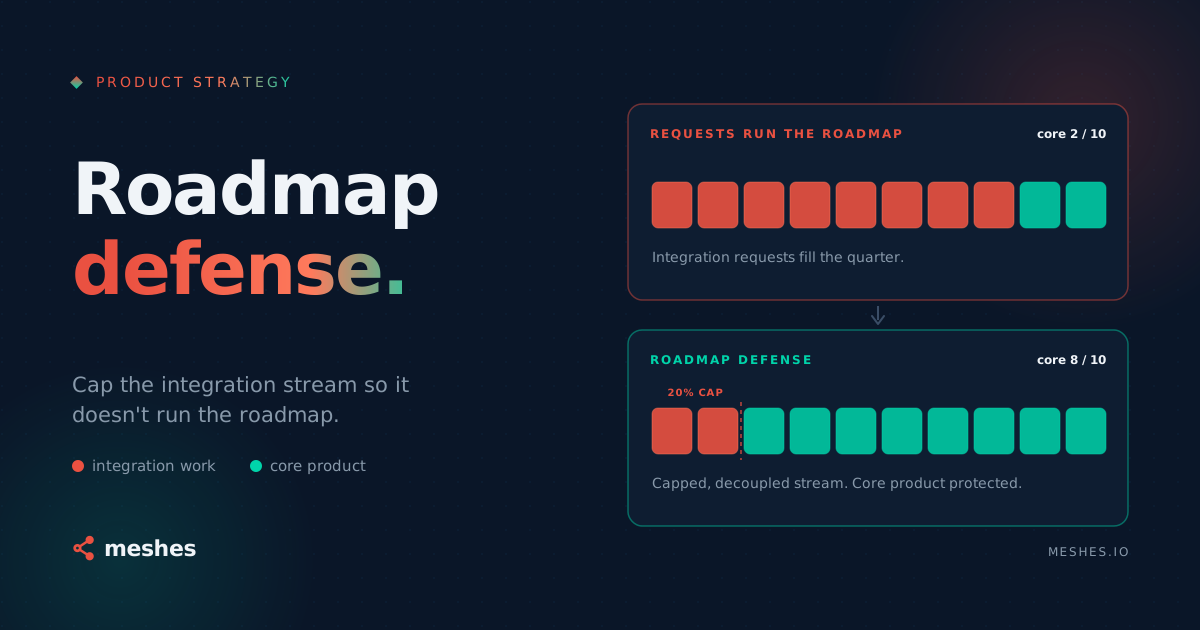
When integration requests start running the roadmap
Customer integration requests can quietly take over a SaaS roadmap. Here's why integration work compounds, why it is hard to deprioritize, and how teams contain it without stalling the core product.
Somewhere between the first few million in ARR and the first real enterprise deal, every SaaS team has the same meeting. Sales has been promising a HubSpot integration for two quarters. Customer support has eight open tickets asking about Salesforce. The biggest deal in the pipeline is gated on "do you sync with Mailchimp?" Someone — the CEO, the head of product, the engineering lead — looks at next quarter's roadmap and realizes the entire team is about to be building integrations.
This isn't a planning failure. It's the predictable result of how customer integration requests propagate through a SaaS organization. The same dynamic plays out in every SaaS company that crosses a threshold where its customers have established stacks of their own tools. Roadmap defense is the work of preventing that pressure from consuming the product.
The challenge isn't that integration work is hard, though it is. The challenge is that integration work doesn't behave like other product work. It resists the normal mechanisms teams use to prioritize, scope, and contain features. Teams that don't develop explicit defenses end up with a roadmap that's mostly other companies' logos.
Why integration requests are uniquely hard to deprioritize
Most feature requests have natural deprioritization paths. A customer asks for a UI change. A product manager weighs it against the roadmap and the strategic theme. The team says "not this quarter" or "this is the use case we're focusing on instead." The customer accepts that answer or pushes back once and accepts it the second time. Integration requests don't move through that process the same way.
They are often deal-gating rather than nice-to-have. A customer who says "I need the Salesforce integration" usually means "I will not buy without the Salesforce integration." Sales does not deprioritize requirements that block deals the same way they deprioritize aesthetic feedback. The escalation path is different, the urgency is different, and the consequence of saying no is measurable in lost revenue rather than diffuse customer dissatisfaction.
Each customer asks for a different integration. Ten customers might produce six different requests, none of which individually justifies a quarter of engineering work. Cumulatively, they justify all of it. Grouping requests by customer workflow and destination makes that demand easier to prioritize.
They have no clean rhetorical defense. A product manager can say "we're focused on improving the core editing experience" and most customers accept that framing. There is no equivalent framing for "we don't believe in integrations." Every modern SaaS is expected to have integrations. The absence of an integration story reads as a gap, not a deliberate choice.
They compound through the sales pipeline. Once HubSpot is shipped, your marketing site lists HubSpot. The next quarter's deals come in expecting that capability and asking what comes next. Each integration shipped raises the baseline expectation for the deals that follow. The work doesn't shrink the queue; it just keeps the queue at the front of the line.
Customer expectations continue after launch. Connection setup, field mappings, and delivery history need to remain clear as customers adopt the integration.
A clear integration commitment
An integration request needs a concrete customer workflow: the event that triggers it, the destination action, the fields that matter, and the expected result. A request for “HubSpot integration” becomes easier to prioritize when it means adding trial users to a specific list or updating a lifecycle property.
The launch criteria should include connection setup, a test event, delivery visibility, and a recovery path. Those observable behaviors give product, sales, and support the same definition of a working integration.
Customer demand and destination coverage
The opposite extreme has its own costs. Lost deals are the obvious one, but the brand cost is also real. Competitors with integration directories use them as proof points in sales calls; "we integrate with fifty tools" is a claim that's hard to counter with "we're more focused." Saying no to integration requests works tactically but rarely scales as a strategy unless the product has a strong technical-buyer audience that prefers to wire its own connections.
The harder version of saying no is saying "not yet" repeatedly. Teams that promise integrations they don't ship damage trust in a way that's hard to recover from. A "Q3 2026" answer that becomes "Q1 2027" and then "Q2 2027" turns the integration request into a credibility issue, on top of whatever it was originally. Customers track these commitments.
Reliability as a launch requirement
The third option — building integrations but building them badly — is often worse than either of the first two. A brittle integration shows up in the marketing site, gets sold against, attracts customers who care about it, and then disappoints them. The support tickets that follow consume customer success time. The reliability gap creates churn risk in a segment of customers who specifically chose the product for that integration.
Reliability matters more in integrations than in most other features because the customer notices the failure twice: once when the data doesn't sync, and again when their downstream process breaks. A signup that doesn't make it to the CRM means the sales rep doesn't follow up. A payment failure that doesn't reach the customer support tool means the support team doesn't see it. A subscription cancellation that doesn't propagate to the marketing automation means the customer gets emailed offers for a product they no longer use. Each of these is a small embarrassment that the customer remembers.
Reliable integrations with three tools are usually more valuable than brittle integrations with ten. The teams that win on integrations tend to be slower to add new ones and faster to fix the ones they have.
What roadmap defense looks like in practice
The teams that survive integration creep tend to make a small set of structural decisions, none of which are unique or clever in isolation but which together change the shape of the problem.
They separate the integration stream from the core product stream. Integration work is staffed as its own line of effort, not as a sometimes-task spread across the team that builds the rest of the product. This is the single most useful defense, because it prevents integration urgency from compounding into core product delays. The integration team can be one person, but it should be allocated capacity, not borrowed from elsewhere.
They cap integration capacity explicitly. A team that says "we allocate a fixed slice of engineering capacity to integrations" has a forcing function for prioritization. The cap forces the question of which integrations matter most, rather than letting the loudest request win the quarter. It also gives sales a clear answer about throughput: "we ship four integrations per quarter, you can vote on which ones."
They develop a clear customer-facing answer before the deal call. Knowing what you say when a customer asks "do you integrate with X?" — for the X you have, the X you're building, and the X you're not building — is a small piece of operational hygiene that prevents most of the integration overpromising that erodes trust. The honest answers are different from the convenient ones.
They distinguish first-party integrations from a self-service integration surface. A first-party integration is a product feature with a UI and an opinion. An open webhook surface plus iPaaS compatibility is a different value proposition. Both are valid choices, but conflating them confuses customers and sales. Teams that articulate the distinction can sell both: "we ship native integrations with these five tools, and everything else connects through standard webhooks."
Customer-facing integrations with Meshes
Meshes lets SaaS teams offer connections, routing rules, field mappings, and delivery history inside their product through embedded workspaces. Each customer configures the tools they use, while your product defines the events those tools receive.
That gives the integration roadmap a concrete scope: which customer workflows matter, which destinations support them, and what event data makes the workflow useful. Retries, fan-out, and delivery visibility are part of the platform experience across those destinations.
The decision frame
The strategic question is how to allocate roadmap capacity to the customer workflows that matter most. Roadmap defense is the work of making the integration stream predictable, capped, and decoupled from core product velocity. Teams that do this well tend to ship more product, not fewer integrations. Teams that don't tend to ship less of both.
The cost of getting this wrong isn't usually a single bad quarter. It's a slow rebalancing of where engineering attention goes, from product work that defines the company to integration work that keeps it operational. That rebalancing is hard to reverse once it sets in. The teams that defend their roadmap early are the ones that still have a recognizable product two years later.
Meshes helps SaaS teams ship customer-facing integrations without letting integration reliability take over the product roadmap. Emit one event, let customers configure their own workspace connections, and keep routing, retries, fan-out, field mappings, delivery history, and replay out of your core app.Start free
Frequently asked questions
Why do customer integration requests keep ending up on the roadmap? Integration requests are often deal-gating rather than nice-to-have, and each customer tends to ask for a different one. Sales escalates them because they block revenue, support escalates them because customers ask repeatedly, and no individual request looks large enough to refuse. The cumulative effect is that integration work consumes more capacity than any single request would have justified.
How much engineering time should a SaaS team allocate to integrations? There is not a universal number. The important move is setting the allocation explicitly — whether that is one engineer, a fixed percentage of capacity, or a per-quarter integration budget — instead of letting integration work expand without limit. An explicit cap forces prioritization between competing integration requests and prevents integration work from compounding into core product delays.
How does an embedded integration layer support the product experience? Meshes embeds customer-scoped connections, rules, field mappings, and delivery history inside your product. Your team defines the product events and how integrations fit the customer journey; customers configure their destinations in their own workspace.
How does integration reliability affect customer trust? Brittle integrations create support load, reliability complaints, and churn risk in the segment of customers who specifically chose the product for those integrations. A signup that doesn't reach the CRM means sales doesn't follow up. A cancellation that doesn't propagate to marketing automation means customers get emailed about a product they've left. These small failures damage trust in a way that's expensive to repair, and they tend to multiply across the integration portfolio over time.
Is it better to have fewer reliable integrations or more brittle ones? Fewer reliable integrations tend to win, especially when those integrations are deal-gating. Brittle integrations attract customers who care about them and then disappoint those customers, which is often worse than not having the integration at all. The teams that handle integration breadth well usually do so by adding integrations slowly and maintaining a higher reliability bar than their volume suggests.